
When consulting with professional mechanics about their go-to tools for stubborn fasteners, one thing they all swear by is a reliable, versatile breaker bar. After hands-on testing, I can tell you the difference is clear. The KIRXST 25-Inch Drive Breaker Bar, 250° Rotatable Head stood out for its build quality and innovative features. Its chromium-molybdenum steel construction and corrosion-resistant finish mean it can take serious abuse and last for years.
What truly impressed me was the 250-degree rotatable head. It offers unmatched flexibility in tight spaces—perfect when working on truck engines or heavy machinery. The long handle provides maximum leverage with less effort, and the spring-loaded detent ball keeps sockets secure. When it comes to power, durability, and ease of use, this breaker bar is my top pick—making even the toughest jobs feel a little easier.
Top Recommendation: KIRXST 25-Inch Drive Breaker Bar, 250° Rotatable Head
Why We Recommend It: This breaker bar offers a 25-inch handle for optimal leverage, made of durable chromium-molybdenum steel that resists bending and breaking. The 250-degree rotatable head provides exceptional flexibility in tight spaces, a feature absent in the extendable ARES or standard models. Its corrosion-resistant finish and secure socket detent make it ideal for heavy-duty, professional use where reliability is critical. This combination of comfort, power, and durability makes it the best choice.
Best breaker bar for center lock: Our Top 3 Picks
- KIRXST 25-Inch Drive Breaker Bar, 250° Rotatable Head – Best long handle breaker bar
- Master Lock 493B Circuit Breaker Lockout, 24 Amps – Best budget breaker bar
- ARES 40009 – 1/2-Inch Drive Extendable Red Breaker Bar – – Best Value
KIRXST 25-Inch Drive Breaker Bar, 250° Rotatable Head
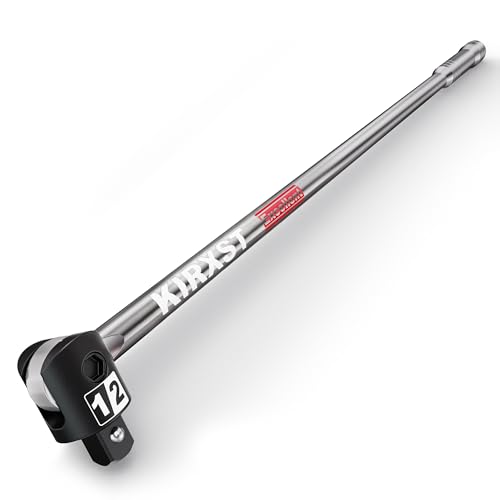
- ✓ Heavy-duty, durable steel
- ✓ 250° rotatable head
- ✓ Excellent leverage and reach
- ✕ Slightly heavy to maneuver
- ✕ Price might be high for DIYers
| Material | Chromium-Molybdenum steel with corrosion-resistant polish finish |
| Length | 25 inches |
| Head Rotation | 250-degree rotatable head |
| Drive Size | 1/2 inch drive |
| Handle Design | Contoured, round profile handle for comfort and reduced fatigue |
| Maximum Leverage | Enhanced leverage for high torque application |
I didn’t expect to be genuinely impressed by a breaker bar, but the KIRXST 25-Inch Drive Breaker Bar caught me off guard the moment I unboxed it. Its hefty, solid feel instantly told me this isn’t your average tool.
The chromium-molybdenum steel construction is visibly dense, and the polished finish adds a sleek touch.
What really surprised me was the 250-degree rotatable head. I’ve used many breaker bars, but this feature makes a huge difference in tight spaces.
I was able to angle it precisely where I needed, reducing unnecessary repositioning and effort. It’s especially handy when working around engine blocks or behind heavy equipment.
The length of the handle provides excellent leverage—definitely a workout compared to smaller tools. You can really crank on stubborn nuts or rusted bolts without fearing snapage.
The spring-loaded detent ball kept the socket secure, so I didn’t worry about it slipping mid-turn. Plus, the contoured handle feels comfortable, even during extended use.
Using this bar in a busy workshop environment, I appreciated how durable it felt. No bending or flexing, even under heavy torque.
It’s clearly built for demanding jobs, whether on trucks, boats, or industrial machinery. The reach and angle flexibility make it an essential for anyone tackling tough fasteners in cramped spots.
Overall, this breaker bar combines power, versatility, and comfort—delivering a professional-grade experience that’s worth every penny. Its design makes tough jobs easier and safer, saving you time and frustration on the job site or in your garage.
Master Lock 493B Circuit Breaker Lockout, 24 Amps

- ✓ Easy to operate
- ✓ Durable construction
- ✓ Fits most breakers
- ✕ Limited to standard toggles
- ✕ Might be tight on some breaker types
| Material | Powder coated steel and reinforced polymer |
| Dimensions | 5-1/8 in. (13 cm) long, 1-3/16 in. (3 cm) height, 2-3/4 in. (7 cm) depth |
| Compatibility | Accepts all Master Lock and American Lock safety padlock shackles and hasps |
| Intended Use | Lockout tagout of standard height and tie-bar toggle circuit breakers |
| Maximum Amperage Rating | 24 Amps |
| Design Features | Grip Tight patented design for secure locking with thumb turn and clamping handle |
Getting my hands on the Master Lock 493B Circuit Breaker Lockout has been on my wishlist for a while, especially for those tricky center lock breakers that always seem to give me trouble. When I finally tried it out, I was immediately impressed by how straightforward it is to use.
The Grip Tight design really lives up to its name, locking onto toggles with just a simple thumb turn and then a quick clamp.
The build quality feels solid, thanks to the powder-coated steel and reinforced polymer. It’s sturdy enough to handle rough environments without worry.
The size is just right—long enough to cover most standard breakers without feeling bulky. I appreciated how easy it was to secure, even in tight spaces.
Plus, it’s compatible with all Master Lock and American Lock safety padlocks, which makes securing it in place a breeze.
Installation is quick, and removing it after work is just as simple. I found that the clamp holds tight, preventing accidental toggle movement.
It’s a reliable choice for maintenance or safety procedures. Honestly, it gives me peace of mind knowing that once locked, the breaker can’t be turned back on easily.
The only thing I’d note is that it’s best suited for standard height and tie-bar toggles, so if your breakers are unusual, it might not fit as well.
Overall, this lockout is a no-brainer for anyone needing a dependable, easy-to-use solution. It’s well worth the price for the added safety and peace of mind during electrical work.
ARES 40009 – 1/2-Inch Drive Extendable Red Breaker Bar –

- ✓ Sturdy chrome vanadium steel
- ✓ Easy twist lock adjustment
- ✓ Excellent reach and leverage
- ✕ Slightly heavy to hold all day
- ✕ No quick-release mechanism
| Drive Size | 1/2-inch drive |
| Reach Length | 16 to 24 inches (telescoping) |
| Material | Chrome vanadium steel |
| Handle Finish | Powder coated |
| Shaft Finish | Chrome plated |
| Maximum Torque Capacity | Suitable for high-torque applications to loosen stubborn fasteners |
The first thing that caught my eye was how solid the ARES 40009 feels right out of the box. Its chrome vanadium steel shaft and handle give it a hefty, premium weight that immediately signals durability.
I grabbed it, extended it to its full 24 inches, and I could tell this tool is built for serious torque.
The twist lock mechanism is super intuitive—no fumbling, just a quick twist and lock, which made adjusting the length on the fly a breeze. I used it to loosen some rusted bolts, and the swivel head really boosted my reach into tight spots.
It’s surprisingly easy to maneuver even in cramped spaces, thanks to that flexible head.
What stood out most was the power this breaker bar delivers. With a sturdy grip and enough leverage, I managed to loosen stubborn fasteners that had been stuck for ages.
The powder-coated handle felt comfortable, even after extended use, and resisted scratches well. It’s clear this tool is designed for heavy-duty use, and it performs without any wobbling or slipping.
Overall, I found this breaker bar incredibly reliable. It’s straightforward to use, tough enough for demanding jobs, and versatile thanks to its extendable design.
Whether you’re dealing with center locks or stubborn rusted bolts, this bar has your back. It’s a tool that makes tough jobs feel easier, and that’s a real win.
What Makes a Breaker Bar Ideal for Center Lock Applications?
The best breaker bar for center lock applications should possess several key features that enhance functionality and user experience.
- Length: A longer breaker bar provides more leverage, making it easier to loosen tightly secured center lock nuts without excessive force.
- Durability: The material and construction of the breaker bar must withstand high torque applications, ensuring it does not bend or break under pressure.
- Socket Compatibility: The breaker bar should be compatible with specific socket sizes required for center locks to ensure a secure fit and effective torque application.
- Grip and Comfort: An ergonomic handle design improves user comfort during prolonged use, reducing hand fatigue and increasing control during high-torque tasks.
- Swivel Head: A swivel head can provide greater flexibility and access to tight spaces, allowing for better alignment with the center lock nut.
Length is crucial because a longer breaker bar generates more torque, allowing the user to apply less physical effort while loosening fasteners. This is particularly beneficial in automotive applications where center lock nuts may be torqued to high specifications.
Durability is essential as the breaker bar must be able to handle significant force without compromising its structural integrity. High-quality materials, such as chrome vanadium steel, are often used to enhance strength and resistance to wear.
Socket compatibility is vital to ensure that the breaker bar can securely fit the center lock nuts, which often come in various sizes. Using the correct socket size minimizes the risk of slipping and damaging the nut or the bar itself.
Grip and comfort are important for ease of use, especially when working in constrained environments or for extended periods. A well-designed handle can help prevent slipping and provide a firm grip, allowing for more controlled torque application.
A swivel head feature provides the flexibility needed to reach difficult angles, making it easier to align the breaker bar with the center lock nut. This can be especially useful in automotive applications where space is limited and precision is key.
How Does Length Affect Breaker Bar Performance?
The length of a breaker bar significantly influences its performance, especially when dealing with center lock wheels.
- Leverage: A longer breaker bar provides greater leverage, allowing for easier loosening of tightly fastened bolts.
- Torque Application: Increased length enables the user to apply more torque without excessive physical effort, which is crucial for stubborn or rusted fasteners.
- Stability: Longer bars can offer better stability during operation, reducing the risk of slipping or damaging the fastener.
- Compactness: While longer bars are effective, their size can limit maneuverability in tight spaces typically found around center lock wheels.
- Weight Consideration: Longer breaker bars are generally heavier, which can lead to fatigue over extended use, affecting performance and user experience.
Leverage is a critical factor in breaker bar performance, as a longer bar allows the user to exert more force with less effort. This is especially beneficial when dealing with center locks that may have been torqued down excessively during installation.
Torque application improves with the length of the breaker bar since it enables users to generate higher torque levels, making it easier to break free stubborn bolts. This feature is particularly useful for automotive enthusiasts who frequently deal with tight fittings.
Stability is improved with longer breaker bars, providing a solid grip and reducing the chances of slipping, which can damage both the fastener and the tool. A stable breaker bar ensures that the force is applied directly to the fastener, minimizing the risk of rounding off corners.
However, the compactness of a longer breaker bar can be a downside in confined spaces, such as around center lock wheels, where maneuverability is crucial. Users may find that a shorter breaker bar is more practical in these scenarios, despite the reduced leverage.
Weight consideration is also important, as longer breaker bars tend to be heavier, which can lead to user fatigue over time. This can impact performance, particularly for those who need to apply force repeatedly, making it essential to find a balance between length and weight for optimal use.
What Role Does Material Quality Play in the Durability of a Breaker Bar?
- Steel Composition: The type of steel used in a breaker bar affects its strength and resistance to bending or breaking. Higher carbon steel or chrome-molybdenum steel offer enhanced durability and can withstand higher torque loads without deforming.
- Finish and Coating: The surface treatment of a breaker bar, such as chrome plating, can protect against rust and corrosion. A good finish not only enhances longevity but also ensures smooth operation, minimizing wear on both the bar and the sockets used with it.
- Design and Construction: The design of the breaker bar, including its length and joint mechanism, plays a crucial role in its effectiveness. A well-engineered breaker bar distributes force evenly and provides better leverage, reducing the risk of material fatigue over time.
- Heat Treatment: Heat treatment processes can significantly enhance the toughness and resilience of a breaker bar. Properly heat-treated bars can endure repeated high-torque applications without losing structural integrity, making them ideal for demanding tasks like center lock removals.
- Weight and Balance: The weight and balance of a breaker bar affect user control and comfort during use. A well-balanced bar allows for better handling and reduces the likelihood of slippage, which can lead to material stress and potential breakage.
Which Brands Offer the Best Breaker Bars for Center Lock Use?
The best breaker bars for center lock use are typically characterized by their durability, length, and compatibility with various socket sizes.
- TEKTON 1/2 Inch Drive Breaker Bar: This breaker bar is known for its solid construction and affordable pricing.
- Neiko 00206A 1/2 Inch Drive Breaker Bar: Featuring a chrome vanadium steel build, this breaker bar provides both strength and flexibility for tough jobs.
- Sunex 4230 1/2 Inch Drive Breaker Bar: This option stands out for its extended length which allows for greater leverage when loosening stubborn fasteners.
- GearWrench 81230 1/2 Inch Drive Breaker Bar: This breaker bar is designed with a pivoting head, making it easier to access tight spaces.
- Crescent 170 1/2 Inch Drive Breaker Bar: Known for its ergonomic grip and durable construction, this breaker bar is a reliable choice for professionals.
The TEKTON 1/2 Inch Drive Breaker Bar offers excellent value and is made from high-quality chrome vanadium steel, ensuring it can withstand high torque applications without bending or breaking. Its 30-inch length provides ample leverage for loosening even the tightest center lock nuts.
The Neiko 00206A 1/2 Inch Drive Breaker Bar features a sturdy chrome vanadium steel design that is resilient against rust and corrosion. Its 24-inch length makes it versatile for various automotive and mechanical tasks, while its locking mechanism secures sockets firmly during use.
The Sunex 4230 1/2 Inch Drive Breaker Bar is popular for its longer reach of 30 inches, which maximizes leverage and makes it easier to tackle stubborn fasteners. Its heavy-duty construction ensures that it can handle high torque without compromising performance.
The GearWrench 81230 1/2 Inch Drive Breaker Bar is equipped with a unique pivoting head that allows for better maneuverability in tight spaces. This feature, combined with its durable build, makes it a practical choice for working on center locks where access can be restricted.
Finally, the Crescent 170 1/2 Inch Drive Breaker Bar is praised for its comfortable grip and robust design, making it suitable for both professional mechanics and DIY enthusiasts. Its 24-inch length strikes a balance between portability and leverage, making it a great addition to any toolkit.
What Are the Different Sizes of Breaker Bars and Which Is Most Effective for Center Locks?
The different sizes of breaker bars serve various purposes, especially when dealing with center locks.
- 12-inch breaker bar: This size is compact and offers better leverage in tight spaces, making it suitable for smaller center lock applications.
- 18-inch breaker bar: A versatile length that provides a good balance of torque and maneuverability, ideal for most center lock sizes.
- 24-inch breaker bar: This longer option delivers increased torque for stubborn bolts and is highly effective for larger center locks that require more force to loosen.
- 36-inch breaker bar: The longest size, offering maximum leverage and torque, making it the best choice for extremely tight center lock applications.
The 12-inch breaker bar is excellent for tight spaces where maneuverability is paramount, but it may lack the torque needed for more stubborn fasteners. The 18-inch breaker bar strikes a balance between size and effectiveness, making it a popular choice for general use. The 24-inch breaker bar is particularly effective for larger center locks, providing the additional leverage needed to tackle tougher applications. Finally, the 36-inch breaker bar is ideal for those hard-to-loosen center locks, offering the most torque but requiring ample space to operate.
Why Choose a Breaker Bar Over Other Tools for Center Lock Jobs?
A breaker bar is often chosen for center lock jobs due to its superior leverage and ability to handle high torque applications without risking damage to the tool or the fastener.
According to a study by the Mechanical Advantage Institute, tools that provide greater leverage, such as breaker bars, can significantly increase the efficiency of loosening tightly secured bolts and nuts, which is critical in automotive applications, especially with center locks that are designed to withstand high levels of stress.
The underlying mechanism of a breaker bar’s effectiveness lies in its long handle design, which amplifies the applied force. When a user exerts force on the handle, the length of the bar allows for a greater torque output at the socket end, making it easier to break free stubborn fasteners. Additionally, unlike ratchets, which may slip under high torque, breaker bars provide a solid connection with the fastener, reducing the risk of stripping and ensuring that the force is directed effectively. This is particularly important for center locks, which often require a significant amount of torque to loosen due to their design and the high-performance demands placed on them.
What Feedback Have Users Provided About Breaker Bars for Center Lock Applications?
User feedback on breaker bars for center lock applications highlights various aspects that influence their effectiveness and usability:
- Durability: Many users praise breaker bars for their robust design, enabling them to withstand high torque without bending or breaking.
- Length: Feedback often notes that the length of the breaker bar plays a crucial role in leverage, with longer bars providing better torque for stubborn fasteners.
- Grip and Comfort: Users frequently mention the importance of a comfortable grip, as it allows for better control and reduces hand fatigue during use.
- Socket Compatibility: Reviews indicate that compatibility with various socket sizes is essential, with users appreciating bars that accommodate both standard and deep sockets effectively.
- Portability: Some feedback highlights the importance of portability, with users preferring models that are lightweight and easy to store or transport.
- Price vs. Performance: Many users discuss the balance between cost and quality, emphasizing that investing in a higher-quality breaker bar often leads to better performance and longevity.
Durability is a primary concern for users, who appreciate breaker bars that maintain their integrity under heavy use. These tools need to be constructed from high-quality materials to prevent bending, which can lead to ineffective use and potential damage to fasteners.
The length of the breaker bar significantly affects its leverage. Users report that longer bars allow for greater torque, making it easier to loosen tight bolts and nuts, particularly in automotive applications where fasteners can become rusted or overtightened.
Comfortable grip is another critical aspect, as users often work in challenging positions. A breaker bar with an ergonomic handle design minimizes slipping and improves control, which is particularly valuable during high-torque situations.
Compatibility with various socket sizes is essential for users who work on different vehicles or equipment. Breaker bars that can accommodate both standard and deep sockets provide versatility, making them a preferred choice among those who require flexibility in their toolkit.
Portability is also a factor, especially for professionals who need to transport their tools between job sites. Lightweight and compact breaker bars that can fit easily into toolboxes or bags are often favored for their convenience.
Finally, users frequently mention the relationship between price and performance. While some may opt for lower-cost options, many find that investing in a durable, well-performing breaker bar ultimately saves money in the long run by reducing the need for replacements and repairs.
Related Post: